
When you sit down with a sharp gouge and a block of raw timber, the material beneath your blade dictates the entire rhythm of your work. Many beginners reach for whatever scrap sits in the garage, which is frequently a piece of construction pine left over from a framing project. After twenty minutes of fighting jagged edges, crushed fibers, and bruised thumbs, they wonder if their tools are dull or if they lack hand strength. More often than not, the fault lies entirely in the species of wood they chose to cut.
Wood is not a uniform plastic block. It is a bundle of hardened plant straws grown under seasonal changes, wind stress, and soil conditions. Deciding between American basswood and pine requires understanding how those straws behave when a steel bevel wedges between them. While both are soft under your fingernail, one behaves like chilled butter beneath a knife, while the other acts more like a deck of cards alternating between soft paper and hard plastic. Exploring how these two common species differ inside reveals why one is the standard for hand carvers worldwide.
Why wood choice changes your carving experience
Why does a knife slice cleanly through one board but tear ragged grooves in another? The answer comes down to shear strength and grain uniformity. When your blade enters a piece of wood, it does not simply part the material like water. It acts as a wedge. The cutting edge severs the cell walls, while the bevel lifts the severed fibers away from the block. If the surrounding cells are firmly bound to one another and share a similar density, the chip curls off in a continuous ribbon. If the cells vary in hardness, the knife path jumps, causing the blade to follow the line of least resistance rather than the line of your design.
This dynamic affects tool safety as much as it affects the visual quality of your project. When a wood species offers predictable resistance, you can regulate your hand pressure with small, controlled forearm movements. When a wood offers erratic resistance, you are forced to push harder to clear a tough spot. The moment the blade breaks through that dense spot into a softer zone, it accelerates unexpectedly. Controlled carving depends on predictable friction, and that friction is governed entirely by the wood species you clamp into your vise.
Tool maintenance also changes based on timber selection. A wood with high mineral content, abrasive silica, or sticky resin pockets demands constant stops for stropping and solvent cleaning. You spend less time shaping forms and more time restoring your edge. Choosing the right blank lets you focus your attention on blade angles, depth stops, and anatomy rather than wrestling with the material itself.
Cell structure and density of American basswood
What makes American basswood (Tilia americana) the gold standard for hand carving? Botanically, basswood is classified as a hardwood because it comes from a broadleaf, deciduous tree that drops its foliage in autumn. In practical terms, however, it is softer than many conifers. Basswood registers roughly 410 pounds of force on the Janka hardness scale, which measures the force required to embed an 0.444-inch steel sphere halfway into the wood. For comparison, sugar maple sits around 1450 pounds, while red oak averages roughly 1290 pounds.
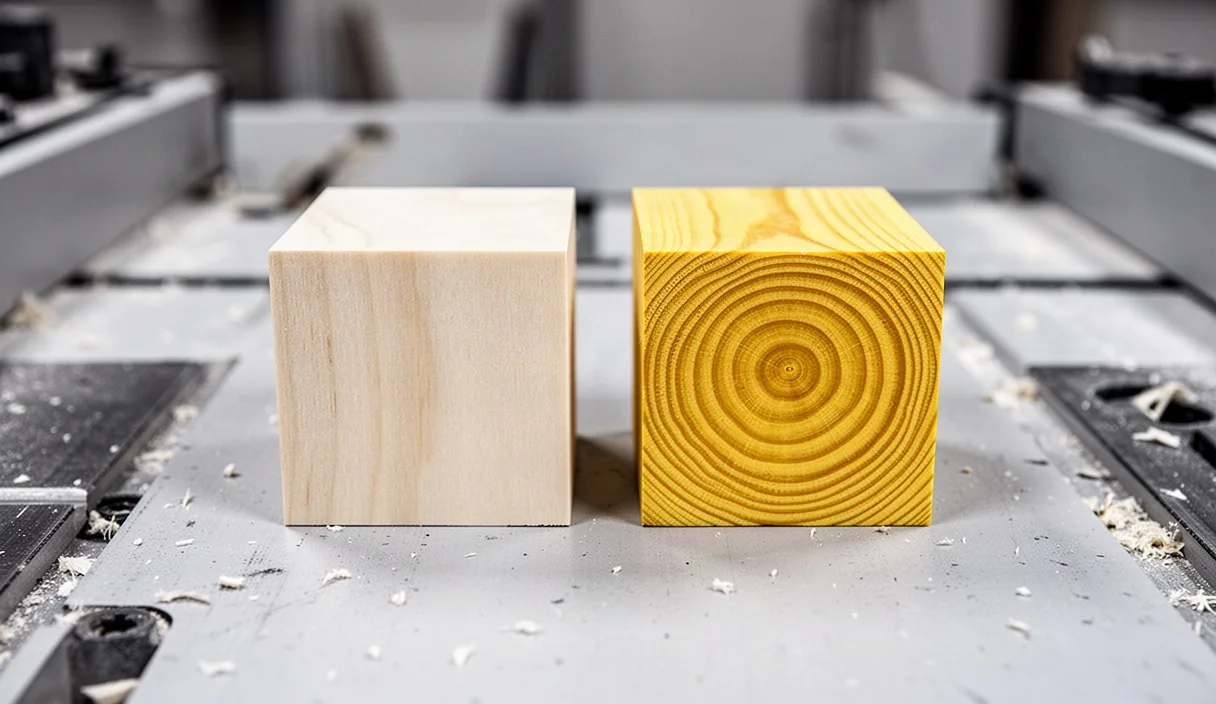
The true secret of basswood lies in its diffuse-porous anatomy. In diffuse-porous hardwoods, the water-conducting vessels are tiny and spread evenly throughout the growth rings produced across the spring and summer. Basswood does not build a dense wall of thick cells when summer heat arrives. Instead, its cells remain consistent in size and wall thickness from the center of the tree out to the bark. When your gouge travels through a block of basswood, the resistance remains almost identical whether you cut across the ring, along the grain, or obliquely down through the growth layers.
This uniform density gives basswood several distinct working properties:
- Minimal tool deflection: The cutting edge stays on its intended track without skating away into softer territory.
- Crisp detail retention: You can carve narrow lettering, fine hair textures, and delicate eyelids without the surrounding wood crumbling under the pressure of the bevel.
- Low dulling effect: Basswood contains virtually no abrasive silica and very little sap, meaning a polished carbon steel edge holds its sharpness across hours of continuous work.
- Uniform color: The pale cream to light tan hue features very faint grain lines, which allows the shadows and contours of your carving to stand out without visual competition from dark wood stripes.
Think of basswood like a brick of high-density sculpting foam or dense cheese. You can push a skew chisel straight down across the end grain, and the fibers will sever cleanly rather than buckling or folding inward. This behavior makes it forgiving for novices learning how to control their cuts and indispensable for professionals executing intricate relief patterns.
The challenge of uneven pine growth rings
Why do so many woodworkers struggle when trying to carve common pine? The difficulty stems from the way conifers produce wood across a single growing season. Pine is a gymnosperm that produces distinct earlywood in the wet spring months and latewood during the drier summer months. Earlywood consists of large, thin-walled cells designed to move maximum volume of sap up the trunk. Latewood consists of thick-walled, compressed cells that provide structural support to help the tree resist wind storms.
This growth pattern creates an alternating sandwich of densities within every annual ring. The earlywood in Eastern white pine is exceptionally soft, often dipping down to 320 pounds on the Janka scale. The latewood band immediately beside it can be twice as dense and heavily fortified with hardened lignin. When your carving knife travels across a growth ring, it moves from a soft, compliant zone directly into a hard, stubborn ridge. The sensation under your hand is like slicing through a loaf of soft white bread that has dry, rigid plastic straws baked into the dough at regular intervals.
This alternation causes several common carving defects:
- Blade deflection: As the edge strikes the hard latewood ring, the bevel tends to climb over the ridge, pitching your knife upward and ruining flat background cuts.
- Crushed earlywood: If your gouge is even slightly dull, the tool will compress the fragile spring cells rather than severing them, leaving bruised, fuzzy hollows that cannot be cleaned up without deep sanding.
- Grain tear-out: When cutting with the grain, the bond between the thin-walled earlywood and the dense latewood can split ahead of the knife, pulling out long splinters and tearing chunks out of your blank.
| Wood Property | American Basswood | Eastern White Pine | Southern Yellow Pine |
|---|---|---|---|
| Botanical Group | Hardwood (Diffuse-porous) | Softwood (Conifer) | Softwood (Conifer) |
| Average Janka Hardness | 410 lbf | 380 lbf | 690 lbf |
| Earlywood/Latewood Difference | Almost imperceptible | Moderate | Severe |
| Detail Capability | Very high (under 1 mm) | Medium (roughly 3 to 5 mm) | Poor (rough forms only) |
| End Grain Behavior | Cuts cleanly with sharp bevel | Prone to tearing and crushing | Prone to splintering and splitting |
Not all pines share the same severity of this problem. Eastern white pine (Pinus strobus) has the narrowest, softest latewood bands of any commercial pine, making it the only common pine species genuinely suited for traditional hand gouges. Yellow pine, Scots pine, and radiata pine display much wider and harder latewood bands, turning detailed gouge work into an uphill battle.
Resin and sap issues with pine lumber
Beyond its uneven grain density, pine introduces another obstacle to the workbench: pitch. Coniferous trees produce sticky oleoresin as a biological defense mechanism against wood-boring beetles and fungal infections. When a conifer is damaged, resin canals rupture, flooding the wound with viscous terpenes that seal the breach. Even long after a pine tree has been felled and sawn into boards, these resin channels remain embedded throughout the heartwood and sapwood.
How does this resin affect your hand tools? As your blade wedges through the wood fibers, friction generates heat at the microscopic cutting edge. This heat softens the semi-solid pitch inside the wood cells. The liquefied resin coats the polished steel bevel of your chisel and binds to microscopic wood dust particles. Within ten minutes of carving, your shiny tool edge is covered in an amber, gummy crust. This crust thickens the profile of the bevel, increasing drag and making a sharp tool feel frustratingly dull.
Pitch pockets also create serious finishing complications once the carving is finished:
- Finishing resistance: Liquid stains and clear finishes cannot penetrate areas saturated with pine sap. Mineral spirits or turpentine must be used to wash the wood surface before any finish will adhere properly.
- Finish bleed-through: Even after drying, warm ambient temperatures can cause buried resin pockets to liquify and migrate outward, creating sticky amber beads that push through paints, shellac, and oil coats months later.
- Sanding gum-up: If you use abrasive paper to clean up tool marks on pine, the frictional heat instantly melts the sap, loading the abrasive grit with hardened lumps and ruining the sandpaper sheet within seconds.
Kiln-dried pine reduces this problem somewhat, as commercial kilns reach temperatures between 160 and 180 degrees Fahrenheit, which bakes and sets much of the volatile resin into a brittle, glass-like state. Air-dried pine or green pine retains fully active sap that will foul your tools rapidly. Basswood, by contrast, possesses no resin canals whatsoever. It contains no sticky pitch, cuts dry, leaves your tools clean, and absorbs stain, oil, or acrylic paint with total uniformity.
Where pine works well and when to avoid it
Despite these challenges, pine is not a useless carving wood. It has served woodworkers for centuries in specific traditions. The key is matching the species to the tool style and the scale of the object. Pine performs poorly under miniature gouges, detail knives, and chip-carving knives where sharp geometry and tight corners are mandatory. However, when shaped with heavy mallets, broad adzes, large drawknives, or power carving burrs, pine shows real utility.
Scandinavian flat-plane carving, large architectural corbels, folk art figures, and timber-frame flourishes often use clear Eastern white pine with great success. In these traditions, the carver makes bold, deliberate cuts that remove large chips in single strokes, deliberately embracing the visible grain lines as an artistic element rather than fighting them. The natural resins also provide pine with moderate outdoor weather resistance, something basswood completely lacks.
Use this simple guideline to decide when pine is an appropriate choice and when you should avoid it in favor of basswood:
- Choose basswood for detailed work: Select basswood for caricatures, human faces, relief panels with figures, letter cutting, and any project that requires delicate features under 5 millimeters wide.
- Choose basswood for beginners: Pick basswood if you are learning hand control. It removes the confusing variable of grain density shifts, allowing you to master safe tool handling without fighting the blank.
- Use Eastern white pine for large sculptural work: Select clear, knot-free Eastern white pine for garden sculptures, large signs with broad V-grooves, life-sized bird decoys, or architectural trim that will be painted.
- Avoid yellow or structural pine: Avoid framing lumber such as Southern yellow pine or spruce-pine-fir (SPF) studs from home improvement centers for any hand carving. These timbers are grown rapidly for tensile strength, creating brutal earlywood-to-latewood transitions and wild grain reversals that ruin hand tool work.
- Avoid pine for natural light-toned finishes: Avoid pine if you want a clean, unstained natural look without strong, zebra-like striping running through your subject's face or body.
Common mistakes
The most frequent error beginner carvers make is buying standard construction two-by-fours from a home improvement store and attempting to carve small figures with a craft knife. Construction studs are fast-grown, sap-heavy softwoods engineered for carrying building loads, not for holding edge details. You end up applying extreme hand pressure to push through the hard grain rings, which dramatically increases the danger of the tool slipping into your holding hand.
Another common mistake is trying to carve pine using the exact same shallow bevel angle used for basswood. A delicate carving knife sharpened to a 15-degree total angle works wonderfully in basswood but can fold or chip when it hits a dense ridge of pine latewood or an unobserved knot. If you must carve pine, increase your primary bevel angle closer to 20 or 22 degrees to support the steel edge against the denser grain bands.
Carvers also often fail to check pine blanks for hidden knots. A knot is simply the dense, hardened base of a branch that extends into the trunk. The fibers around a knot swirl in chaotic circles, and the knot itself can be three times harder than the surrounding timber. If your gouge strikes a knot unexpectedly while taking a deep cut, the edge can easily chip, requiring substantial grinding to repair.
Next steps for your carving project
To set yourself up for a clean, enjoyable carving session, take these practical measures before you make your first cut:
- Source genuine woodcarving blanks: Purchase a kiln-dried, defect-free block of Northern basswood from a dedicated woodcraft supplier rather than relying on hardware store scrap. Request clear stock with straight, parallel grain lines running from end to end.
- Inspect your blank on all four sides: Look at the end grain. If you see wide, dark summer rings separated by pale, spongy bands, you are holding a problematic conifer. If the end grain looks creamy, indistinct, and uniform across the entire surface, you have a cooperative piece of basswood.
- Refine your cutting edge: Polish your chisel or knife on a leather strop dressed with aluminum oxide or chromium oxide compound until it shaves hair without catching. Basswood demands razor sharpness; because it is soft, a slightly dull tool will compress its fibers instead of severing them cleanly.
- Wear personal safety gear: Put a cut-resistant carving glove on the hand that holds the wood blank, and wear a leather thumb guard on your tool hand. If you use mallet gouges, secure the workpiece directly to your bench using a heavy woodworking vise, bench dogs, or holdfasts rather than your fingers.
- Take thin test cuts: Make a few shallow test cuts across the corner of the wood block. Listen and feel. A healthy cut in proper basswood makes a quiet, crisp swishing sound and yields a curled, paper-thin shaving that holds its shape without snapping.